

 English
  中文简体
中文简体  Español

Jiangsu Mingchanghe Technology Co., Ltd.
Jiangsu Mingchanghe Technology Co., Ltd.
Jiangsu Mingchanghe Technology Co., Ltd.
Jiangsu Mingchanghe Technology Co., Ltd.
Jiangsu Mingchanghe Technology Co., Ltd.
Jiangsu Mingchanghe Technology Co., Ltd.
Jiangsu Mingchanghe Technology Co., Ltd.
Jiangsu Mingchanghe Technology Co., Ltd.
Jiangsu Mingchanghe Technology Co., Ltd.
Jiangsu Mingchanghe Technology Co., Ltd.
Jiangsu Mingchanghe Technology Co., Ltd.
Jiangsu Mingchanghe Technology Co., Ltd.
Jiangsu Mingchanghe Technology Co., Ltd.
Jiangsu Mingchanghe Technology Co., Ltd.
Jiangsu Mingchanghe Technology Co., Ltd.
03 Sep 2026, Posted by MCH
ASA/ABS Sheets: Co-Extruded Weatherable Stock for Thermoformed Outdoor Parts
Content
Ask anyone who has bought vacuum-formed machine hoods, and the story repeats: parts formed from plain ABS look sharp on delivery, then spend two or three summers in the sun turning pale, chalky, and brittle at the edges. The plastic did not fail mechanically. The butadiene rubber inside ABS cannot stand up to ultraviolet light, and that single limitation is the reason ASA/ABS sheets exist.
The short answer for buyers: form outdoor-facing parts from an ASA/ABS coextruded sheet, and reserve plain ABS for parts that live indoors or inside enclosures. The ASA cap layer takes the weathering duty, while the ABS core keeps the impact strength and forming behavior your existing tooling already expects. The sections below explain how the structure works, what to specify, and where the extra cost pays for itself.
What an ASA/ABS Sheet Actually Is
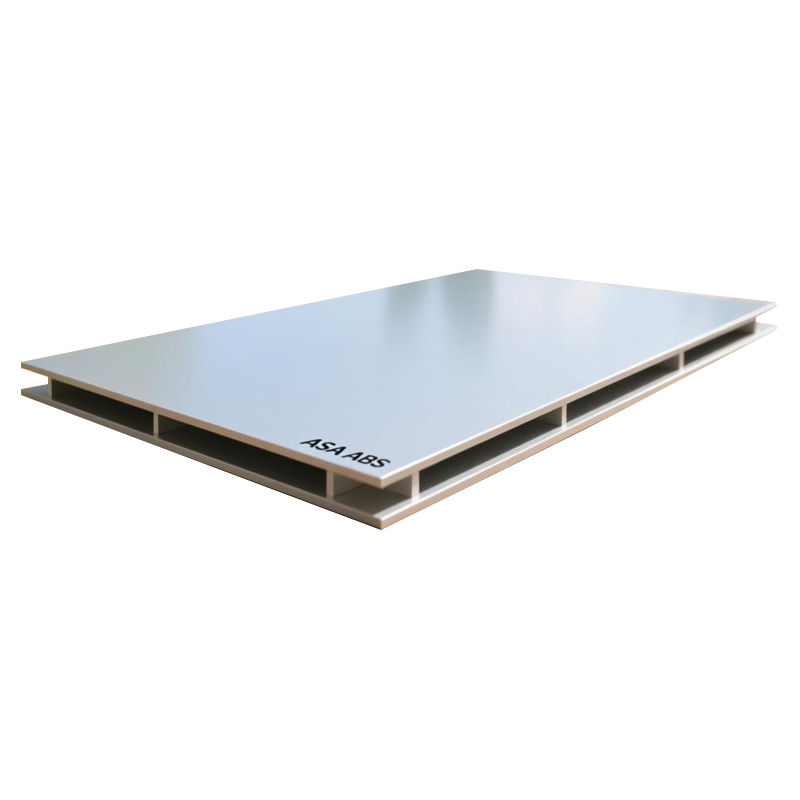
An ASA/ABS sheet is a coextruded product, not a blended compound passed through the die once. The extrusion line feeds two polymers through a shared die at the same time: a skin of ASA (acrylonitrile styrene acrylate) over a core of ABS. Single-sided constructions place ASA on the weather-facing surface; two-sided versions, usually written as ASA/ABS/ASA, protect both faces of the finished part.
The chemistry gap between the two layers is small in name and large in outcome. Both are styrenics with an acrylonitrile phase for stiffness and a rubber phase for toughness. In ABS, that rubber is butadiene, and its molecular structure is exactly what UV light attacks. In ASA, the rubber phase is an acrylic ester instead. Swap the rubber, and the surface stops yellowing and chalking under sunlight.
The Cap-and-Core Division of Labor
The ASA skin is thin relative to the core, often a small fraction of total gauge, but it carries nearly all of the weathering work. Because the cap is pigmented through its full thickness, color is integral to the surface rather than sitting in a paint film. A scratch may expose a different shade underneath, but there is no paint to flake off the way a sprayed finish does.
The ABS core contributes the properties that make the sheet worth forming: high impact strength, good melt strength for deep vacuum draws, and forming temperatures close to standard ABS. In practice, that means existing thermoforming tools and heater profiles transfer over with minimal re-qualification.
ASA/ABS vs. Plain ABS and Solid ASA
For most sourcing decisions, three candidates sit on the table: plain ABS sheet, ASA/ABS coextruded sheet, and solid ASA sheet. Each has a defensible place. The common mistakes are paying for weatherability a part will never need, or skipping it for parts that clearly do.
| Property | Plain ABS sheet | ASA/ABS coextruded sheet | Solid ASA sheet |
|---|---|---|---|
| Outdoor color and gloss retention | Poor; yellows and chalks under UV | Good on capped faces; the cap carries the weather duty | Good through the full thickness |
| Impact toughness | High | High, driven by the ABS core | Good, generally harder and stiffer than ABS |
| Thermoforming behavior | Easy, wide processing window | Close to ABS; deep draws and texture detail transfer well | Formable but stiffer, may need adjusted settings |
| Relative cost | Lowest | Middle; the premium covers the cap layer | Highest at equivalent gauge |
| Best fit | Indoor housings, interior parts, packaging | Outdoor housings, vehicle exterior trim, signage | Severe-exposure parts needing full-depth weatherability |
One more comparison matters in practice: ASA/ABS versus painted ABS. Painting adds a process step, a failure mode in the form of chips and peeling, and repaint logistics over the service life. An integral ASA cap removes the paint shop from the equation for colored outdoor parts, which is why many automotive and outdoor-equipment programs have moved this way.
How to Specify an ASA/ABS Sheet
Gauge, Cap Layer, and Capped Faces
Most thermoformed parts in this family fall between roughly 1.5 and 6 mm in total gauge, with heavier gauges reserved for structural panels. Two questions belong in your RFQ from the start: how many faces carry the ASA cap, and what share of total thickness the cap represents. A part that only shows one face to the sky can often be bought single-capped at a better price, while a double-sided sign or spa panel needs protection on both faces.
Color, Gloss, and Texture
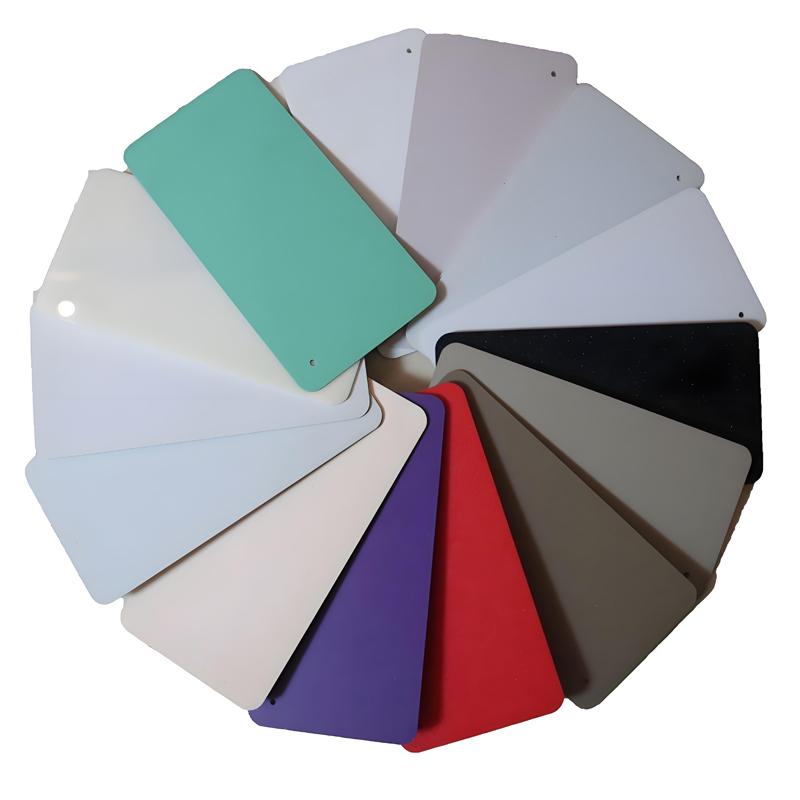
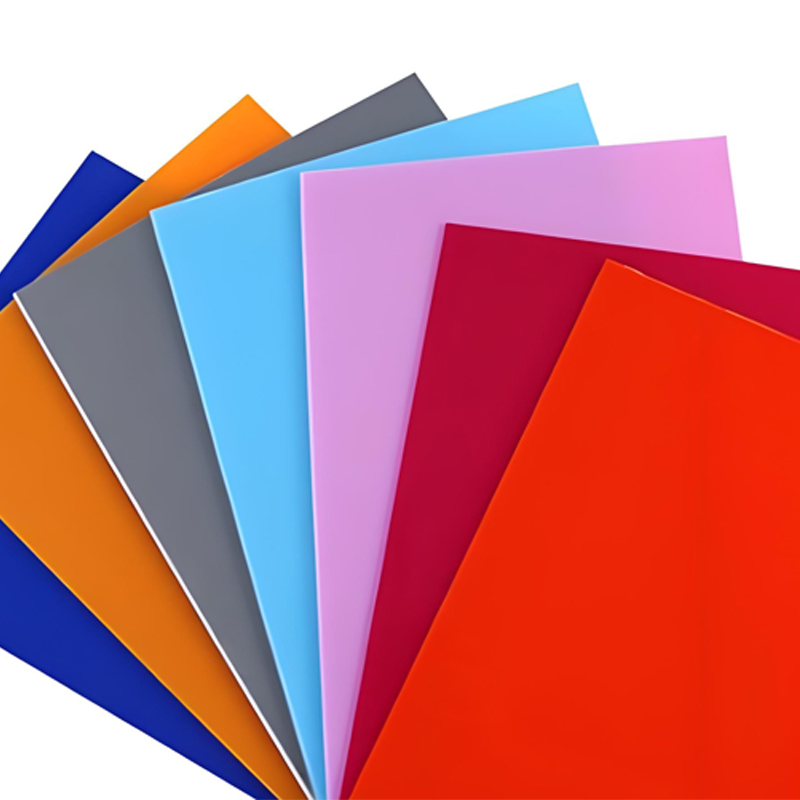
Because the color lives in the cap layer, color matching is a cap-layer exercise. Suppliers can match a target shade and offer gloss levels from high-gloss to fine-textured matte; textured surfaces also hide tool marks and minor scuffs on large parts. Ask for a signed-off color plaque and keep it as the acceptance reference for every batch.
Weathering Data Worth Asking For
"Weatherable" means little without numbers. Ask the supplier for color difference (delta E) and gloss retention after a defined accelerated exposure, for example xenon-arc testing following ISO 4892 or UV fluorescent exposure following ASTM G154, and agree on the exposure hours and pass thresholds before production. That single document prevents most disputes about fading after delivery.
Forming and Finishing on the Shop Floor
On the floor, ASA/ABS behaves like the ABS core it is built on. It vacuum forms and pressure forms with the melt strength needed for deep draws, picks up fine texture detail from the mold, and trims cleanly. Adhesives and solvent cementing developed for styrenics generally work, and paint or decorative film can still be applied when a project calls for a special effect.
Two practical cautions apply. Keep the protective PE masking film on through forming and handling until final assembly, because a scratched cap is the one defect this material cannot hide by design. And if the part specification calls for flame retardancy, confirm that an FR-modified version is available in the same construction instead of assuming the standard grade will pass.
Where the ASA Cap Pays for Itself
The economics are simple. The ASA cap costs more than bare ABS, and it earns that money anywhere sunlight reaches the part for years:
- Automotive and commercial-vehicle exterior trim: spoilers, mirror housings, grille surrounds, truck body components, roof boxes.
- Outdoor power equipment: lawn-tractor hoods, trimmer and chainsaw shrouds, generator enclosures.
- RV and caravan parts: body panels, wheel-arch covers, roof-mounted equipment housings.
- Enclosures for telecom, electrical, and water infrastructure that sit outside year-round.
- Outdoor signage and advertising displays, garden and patio furniture, spa panels, and agricultural equipment housings.
Indoor parts rarely justify the cap: appliance housings inside a building, interior trim, material-handling trays, and automotive interior components all do fine on plain ABS. Drawing that line clearly at the bill-of-materials stage is where the savings live.
A Buyer's Checklist Before Ordering
- Confirm how many faces are ASA-capped and the cap's share of total gauge.
- State the target color and gloss, and sign off a color plaque before production.
- Request delta E and gloss-retention data from accelerated weathering, with agreed hours and thresholds.
- Confirm gauge, flatness, and sheet size tolerances, plus protective masking on capped faces.
- Ask early about FR grades if the specification or end market requires them.
- Agree how batch-to-batch color will be controlled on repeat orders of custom shades.
Choosing a Supplier for ASA/ABS Sheets
Because ASA/ABS is a coextruded alloy product, the supplier's formulation and line capability matter as much as the datasheet. Jiangsu MCH Technology (MCH) builds its range around the ABS family: ABS, flame-retardant ABS, PC/ABS, TPU/ABS, and ASA/ABS sheets, alongside HDPE, HIPS, and PMMA. The company customizes color, thickness, pattern, and size across three production lines, with exports to Europe, the Americas, Southeast Asia, and the Middle East. For a buyer, that breadth matters in a practical way: when a program mixes indoor ABS parts with outdoor ASA/ABS parts, one supplier can hold color and gauge logic across both.
Start the conversation with the part rather than the material name: where it lives, which faces see the sun, the target gauge, the color and gloss standard, and the weathering thresholds you will accept. With those five answers on the table, an ASA/ABS quotation becomes a specification instead of a guess.
Related products

GET A QUOTE
Copyright © Jiangsu Mingchanghe Technology Co., Ltd. All Rights Reserved Engineering Plastic Sheets Manufacturers
